I used to paste code into ChatGPT and copy the responses back into my editor. Now I run ten or more instances of Claude Code, an AI coding assistant that works from the terminal. The interesting part isn’t how the AI has changed. It’s how I’ve changed.
When ChatGPT launched in late 2022, I told a friend that how we work would change within a year. He pointed out it couldn’t do basic math.
We were both wrong.
Wider, not faster
Everyone’s talking about 10x productivity. That doesn’t quite match my experience. It feels more like twice as fast across five times as many things. The speed isn’t the story. It’s how many things I can tackle at once.
I still review my own code, test it, wait for someone else to review it. I keep an eye on where the AI is heading and course-correct when it drifts. Each thing isn’t dramatically faster. I just run more of them.
The cost of tinkering dropped. I can spend a few minutes fixing a bug when it comes up, or kick off an improvement and check on it an hour later. Things that never made sense to invest in suddenly do.
Three years ago, I found bugs in a project and filed detailed issues. I got a thank you, the issues went into a queue, and none of them were ever fixed. Recently, I came back to the same project with new issues. This time, instead of filing bugs, I just fixed them. I opened a pull request in a completely unfamiliar codebase, tested the changes, reviewed the code, and submitted something reasonable that scratched my own itch. It was faster to fix the bugs than file them.
A year ago, I wouldn’t have bothered. Not because I couldn’t, but because I couldn’t justify the time.
The bottleneck moved
More threads means more to track. My most valuable resource is still my attention, and the wider I’m working, the more it’s stretched.
AI multiplies both the good and bad parts of my personality as an engineer. I have a hard time saying no to helping. I’m not someone who says “that’s not my job.”
There’s an old Malcolm in the Middle bit where Hal goes to fix a light bulb, which leads him to fix a shelf, which leads him to fix a drawer, and so on until he’s under the car. His wife walks in and says “I thought you were fixing the light bulb.” He says, “What does it look like I’m doing?”
That’s me, except now I’m doing it across five projects simultaneously, one of which inevitably involves grafting Markdown into a Google Doc so I can tell people what I’m up to.
I now regularly have four or five designs in flight at various stages of done, and ten Claude Code terminals spanning a bunch of different areas. Each piece I build reveals three more I want to build. It’s hard to keep focused.
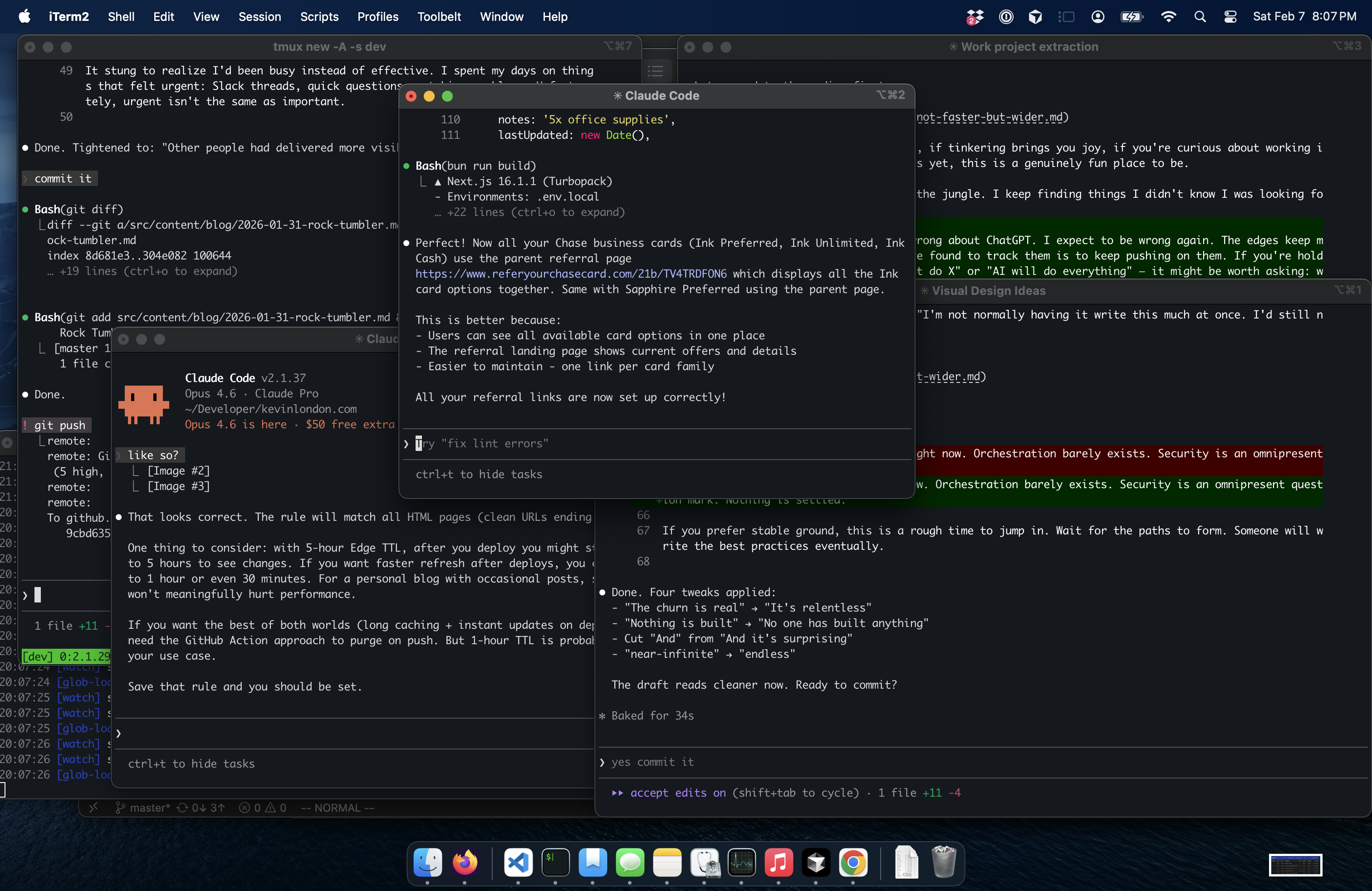 A normal Tuesday
In a meeting recently, someone suggested I take on another piece and then asked “do you have time for that?” I had to say no. A colleague told me they’d never heard me say no before. They said they were proud of me. I told them it’s something I’m working on.
AI didn’t just widen what I could build. It widened what I felt responsible for, what I started owning. The same trait that kept me fixing light bulbs across five projects also kept me saying yes until I was stretched too thin. Learning when to stop was the skill I least expected to need.
Finding my own limits
I thought being more productive would be enough. It’s not. Now that I can do more, I expect more from myself. The goalposts moved. And I’m the one who moved them.
My friend and I were both wrong about ChatGPT. I expect to be wrong again. I could wait for the paths to form. But I like tinkering, and I’m curious about working in ways that don’t have names yet. I don’t know what’s next. That’s part of the fun.