Some days, I have 20 open agent sessions, and only 5 of them are important. But which 5 can be a mystery when they all ask for my attention.
Before AI, I might’ve had 6 open threads and 3 or 4 of them mattered. Marginal work has a way of expanding faster than important work.
In theory, the thing I’ve always wanted to do is a prompt away. In practice, if I’m the mouse, the agent is happy to give me a cookie, but I’m still going to want a glass of milk. It’s never just a cookie.
So I need some process to push back.
Three goals and a chief of staff
I track my priorities, defining what I want to do each quarter, year, or longer. From each milestone, I think about what my goals should be for the month and, from that, define goals for the week.
For example, in a week not so long ago, I needed to transition to a new domain, and hand off the one I previously owned at the end of the month.
My goals for the week:
- Write a draft doc about overlap with another team and align with them on direction. We had two different platforms and I wanted to consolidate.
- Start the handoff doc for what the new owners would take over.
- Get up to speed on my new domain. Make one or two small, meaningful contributions, even something as simple as improving onboarding docs.
Monday morning, I started a new AI session and ran my /chief-of-staff skill with “Here’s what I’d like to accomplish this week. <goals above>. What should we do first?”
(A skill is a kind of saved prompt, a Markdown file with directions for how to do something, which you can invoke by name. It sounds dumb, but that’s what it is.)
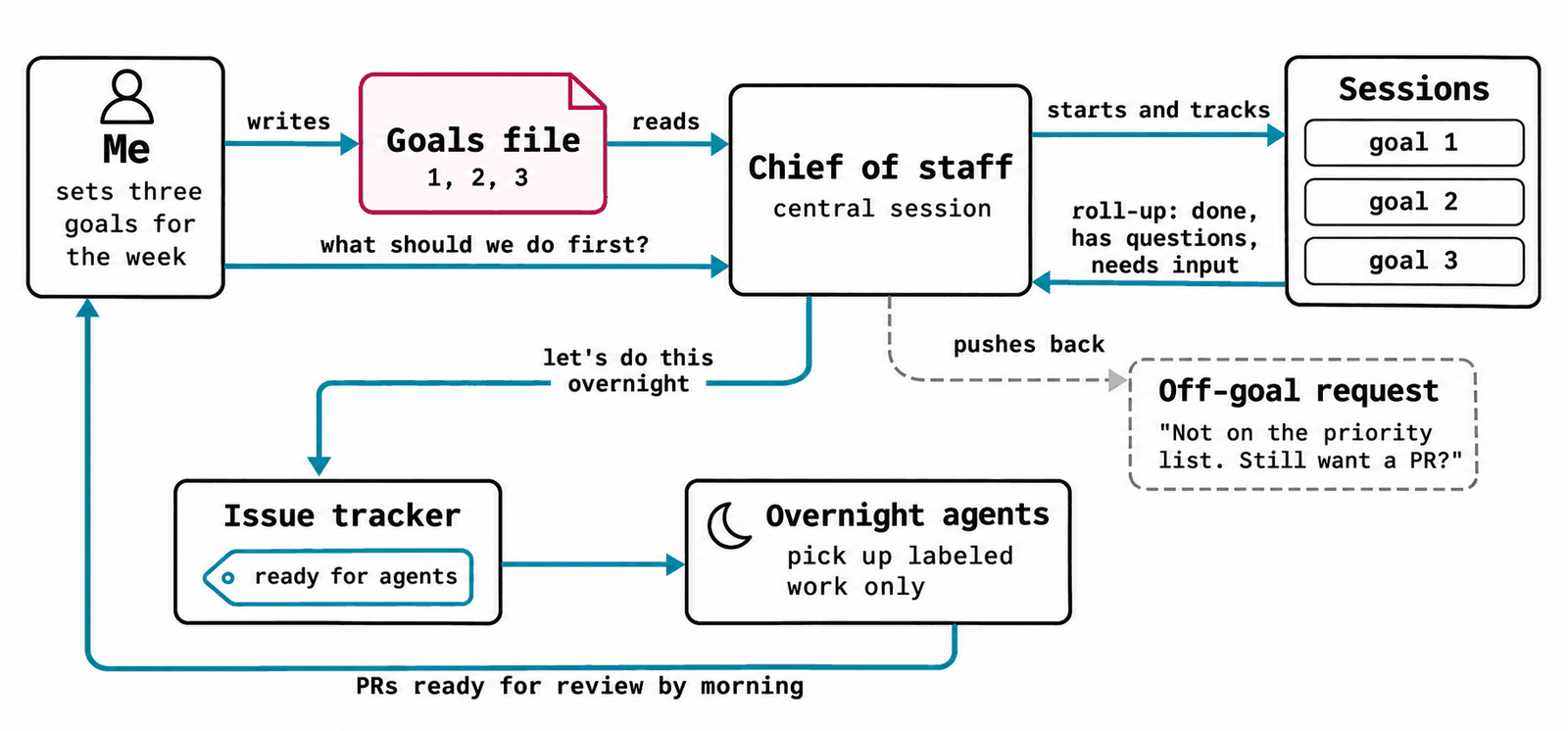
My “chief of staff” is a central session that starts other sessions and tracks them. I can see and talk to any of the managed sessions directly, or look at the roll-up in the main session. For example: this session finished and needs my input, this one has questions, this one is ready to wrap up.
I write my goals in a goals file. My chief of staff reads it, and I’ve tasked it with helping keep me on track. It won’t typically open pull requests (PRs) or do work off-goal, so if I do get distracted, it will gently push back. It says something like “Do you want me to open a PR for this? It’s not on the priority list for the week.”
I aim for three priorities. Sometimes I start with three and balloon to eight. Then I have to examine what I’m doing with my life. It’s awful when an agent says “I’m doing something aligned with goals 7 and 8.” WTF are goals 7 and 8? If it’s three, I can manage.
Committing to the goal
From the week’s three goals, I decided to start on the alignment doc first. Alignment work, where there could be disagreement or pushback, is tempting to put off. Committing to the goal encouraged me to have an uncomfortable conversation.
That Monday, an agent wrote the initial outline.
I have a second brain repo where I keep all my docs, so my agent can see what I’ve written before. The agent said something like “It looks like there’s a discussion several months ago where it was agreed these would be separate. What’s changing?” That shaped the intro of my alignment doc. Then, I hand-wrote most of the first draft.
Lingering commitments
While I try to focus on my goals for the week, there’s so much opportunity for distraction, for work which feels important in the moment but just makes me busy.
It’s too easy to spin up an agent for every Slack thread where you think you can help. Okay, I shouldn’t say you. I find it too easy. Then I have all these lingering commitments to follow through on. I have to say no to things even when I could do them (see Two tables).
Still, agents sneak in work they think I should do, like a routine package upgrade. Just as before AI, everything I say yes to is something else I’ve implicitly said no to.
One time I did an agent-led architectural review thinking, oh, maybe we can do some reorganization here. It kicked off 6 or 7 PRs. Some were refactors while others introduced a new seam that the agent said was fine. It seemed risky. There’s that pit in my stomach feeling when shipping a big change, especially if I haven’t vetted it. I closed most of the PRs without merging.
I can make a call to close PRs an agent created, but it’s harder to address my own habits. Previously I monitored and answered questions in a support channel and when customers reported bugs, I fixed them. I told the new owners I would be less active in the support channels. They knew that was coming, but I had a hard time handing it off.
It’s nice to feel useful, to help someone and get instant feedback. It takes discipline not to pursue lots of little dopamine hits while accidentally starving bigger priorities.
So instead of spinning off new sub-sessions for customer reports, I notified the new owners. Sometimes I added “I think it’s this”, but without fixing it myself or asking my agent to look into it.
Overnight work
On Monday, I asked an agent to enqueue research overnight to find stats and specifics for our overlap, and what we should incorporate on our side.
During the day, when I said “let’s do this overnight,” the agent filed it in a local issue tracker with a label that marked it as ready for agents. Overnight agents only picked up work with that label, because if I had them burn down a whole backlog, they’d open a ton of PRs I didn’t care about.
After hours, I liked to have agents do mundane tasks, such as:
- Go through my open PRs, fix failing builds and merge conflicts, and address review comments if they’re worth doing. The goal is to get it ready for my review by morning.
- Research: find what I could be doing better, what’s changing, what might impact my timelines.
- Review our team’s ops channel. Which alerts can we fix or improve? If they’re noisy, should we reduce how often we send them to prevent fatigue? Can we address the underlying issue?
The best overnight work doesn’t require me to have more hours in the day. The nightly PR process fit well because it reviewed work I’d already committed to.
I scheduled the chief of staff to check whether enough work was ready for overnight. I also scheduled worker sessions to pick up ready tasks. I wasn’t going to be there to kick it off at 2 a.m. The scheduled prompt knew my limits, such as no more than five PRs overnight, and to only do work aligned with my goals.
Monday’s overnight research found that recent metrics for the partner team seemed to be missing. I flagged it to them and said maybe I’m missing something? They investigated and fixed the reporting.
Where I stay involved
Tuesday, I reviewed the research and combined it into the doc. If I hand an agent too much, I delegate my brain. In the old way of working, I understood things because I discovered them, weighed them, debated them, chose alternatives. Now when a solution is presented to me, it doesn’t fit in my head as well.
Wednesday, I read through the document and edited it, finishing with a read-aloud. The read-aloud helps because it forces me to understand what I’m talking about, at least enough to explain it without interrupting to go “what does that mean??” If I need a human to understand something I’m doing, I have to be the one to explain it, because if they have follow-up questions, I want to answer them without asking an agent.
I pre-shared it to get alignment before the review.
When I joined Amazon in 2017, Jeff Bezos still talked about one-way and two-way door decisions. A two-way door is easy to undo, a one-way door decision is costly to change.
For one-way doors, like the consolidation, I watch closely, giving thorough feedback over multiple rounds. For two-way doors, I’m inclined to give the agent a little leash.
Thursday we had the review. We aligned quickly and agreed on next steps before the end of our meeting time.
The other team asked how I wrote the doc with AI. I replied that I mostly didn’t. AI did the research, supported me as I wrote it, and acted as an editor. But I wrote it.
I pasted the meeting notes into my session, incorporated feedback into the doc, and sent out action items.
Instead of the open-ended architectural review, I now had the right artifact to hand to an agent for pursuing my goal: an aligned design doc.
After the meeting, I said to the chief of staff something like “let’s start up sessions for work from the design doc based on the milestones. Let’s aim for 5 PRs initially, feel free to work in parallel.”
When an agent opens a PR, there are still usually problems with it. Overnight, the scheduled self-reviews ran to get the PRs ready for my feedback on Friday.
As I review code, I look for architectural smells, and take a zoomed-out view beyond a single PR.
I say things like “hm, are you sure about this?” “Should we pull out that abstraction?” “What validation did you do on this?” “What about the other PR that does something kind of similar?”
In one PR, my agent deleted a bunch of code from the partner team’s code base, but we hadn’t agreed that was what we would do first. It was premature. So I closed that PR, even though it was ready for human review, with a plan to reopen it later.
After a few rounds of iteration on the rest, I collected the 4-5 polished PRs and asked for team feedback and approvals.
As agents get more capable, I revisit my workflow and what I’m comfortable delegating. Sometimes the limiting factor isn’t agent capability. It’s judgment and human perspective.
We aren’t agents working for agents. We’re humans working with humans, using agents to get work done.
The handoff and the new domain
For the handoff document goal, I started the outline with something like “Look at my open PRs, and our team goals for the quarter. Here’s a voice riff of recommendations for what we could build next quarter. Help me put together a doc for the new owners.”
The agent built a list of tasks and open threads, including some less important ones I removed. I structured the handoff into three primary focuses, similar to the goals.
For the new domain onboarding goal: “Locate and read through the key design docs for the new domain, prepare a short overview doc for me.”
Although I reviewed the agent’s findings, what helped me ramp up most was:
- 1:1s with domain experts and asking what I need to know, what we’re doing now, what we should do next.
- Prep materials another engineer put together, including an AI-generated video narration of how systems fit together.
- Reading the most important design docs, which again had been highlighted by humans.
That first week, I looked at improving visibility (graphs, dashboards, a report) because those are two-way doors. And people would tell me if I had gotten it wrong, also helpful.
As I left for the weekend, I had completed one (alignment doc) and made progress on two (handoff doc, new domain). For most weeks, that’s better than my average.
The next Monday, I came in and wrote down my goals all over again.
What I dropped and what stuck
I’ve built my workflow by experimenting, making mistakes, taking two steps forward and one back, and it works well enough for me. It’s also not finished, it won’t be.
The morning brief trap
For a while, I had an agent prep a short briefing doc to start my day.
Most mornings, I didn’t care to read it. What it did overnight was, by design, so mundane that I didn’t want it to require my attention. I regularly returned to a 700-word brief and two or three 2,500-word docs, and it implied that I wasted its time by not reading the docs yet.
And I didn’t want to answer four or five cryptic approve-these items: “Decision packet: I need your take on these five things. One: a coworker needs to know whether you want to action the threshold limit increase or the atomic trade-off. Two: the fault artifact needs your go.” … Huh?
When I start my day, I want to start working, not reading.
Advice lightning round
- Make a goals file, and maybe a skill, where you check in with your agent.
- Find what’s useful as overnight work for you. Maybe start with overnight PR self-reviews, merge conflict resolution, and addressing bot feedback. If you let agents open PRs overnight, set a limit and ensure the PR aligns with your goals.
- Try reviewing code yourself, then ask an AI agent what you missed.
- After you’ve written a doc, ask an agent for editorial feedback. I’ve done this with this post, where I have a guideline that it’s not allowed to write, but it can provide a useful perspective.
Loose ends
Some days I’m disciplined and only have 3-4 sessions open. Some days it’s 6. On bad days, I have 20.
If the session aligns with a goal, I’ll keep it going. If the session’s a loose end or non-critical, I’ll archive it so it stops distracting me. It’s pruning unproductive branches of the tree. In the true ideal, I would not create this unnecessary work to begin with.
I’ve meditated on and off since 2009. In meditation, the goal is usually to focus on something, like the breath. It sounds so simple, and it’s a constant battle. The brain is like, oh, there’s this thing I forgot about, or who might win the British Bake Off?
In meditation, as in work, the best case is to not get distracted. Failing that, second best is to notice it quickly. The third best is to notice I’ve gotten distracted at all. And some days that has to be enough.
Thanks to Brian Sandoval and Andy Fries for feedback.